
1. What does the Marion County Board of Developmental Disabilities do?
The Marion County Board of Developmental Disabilities (MCBDD) serves over 1,000 individuals with disabilities in Marion County. Many people receive services in more than one area of need. We provide support and resources in the following ways: Early Intervention, School Age Support, Therapies, Community Integration, Employment Support, Service and Support Administration Services, Investigative Agent Services, Family Resources, Residential and Adult Day Service (ADS) Programs, Adaptive Equipment, Remote Technology Supports, and Special Olympics Programs.
2. Who receives services from MCBDD?
To receive services, an individual must have a qualifying diagnosis documented before the age of 22 and be deemed eligible through an assessment process. The diagnoses vary, and so do the levels of support. Each person served is unique. MCBDD serves approximately 1,000 people in the Marion County community with developmental disabilities each year. The ages of those we serve can range from birth to the end of their lifetime. We currently have a two-month-old and an 84-year-old, as well as every age in between. A lot of life happens from birth to death, and MCBDD is here to support those we serve in leading the most independent and inclusive life possible. Our mission is to allow those we serve to live, learn, and earn in our community.
3. How are those services arranged?
MCBDD has Services and Support Administrators (SSAs) who serve as advocates and allies to help those served achieve their goals. The goals are set and outlined in a plan each year. The plan is referred to as an Ohio Individual Service Plan, or OISP. An OISP is a collaborative effort between the team, put together by the SSA and the person served, to help them succeed, create goals, and obtain the necessary support to achieve the goals outlined in the plan. The team can include the person served, the MCBDD Service and Support Administrator, family members/caregivers, friends, providers, and additional community resources.
4. Explain the current proposed tax levy that is on the May 2026 ballot.
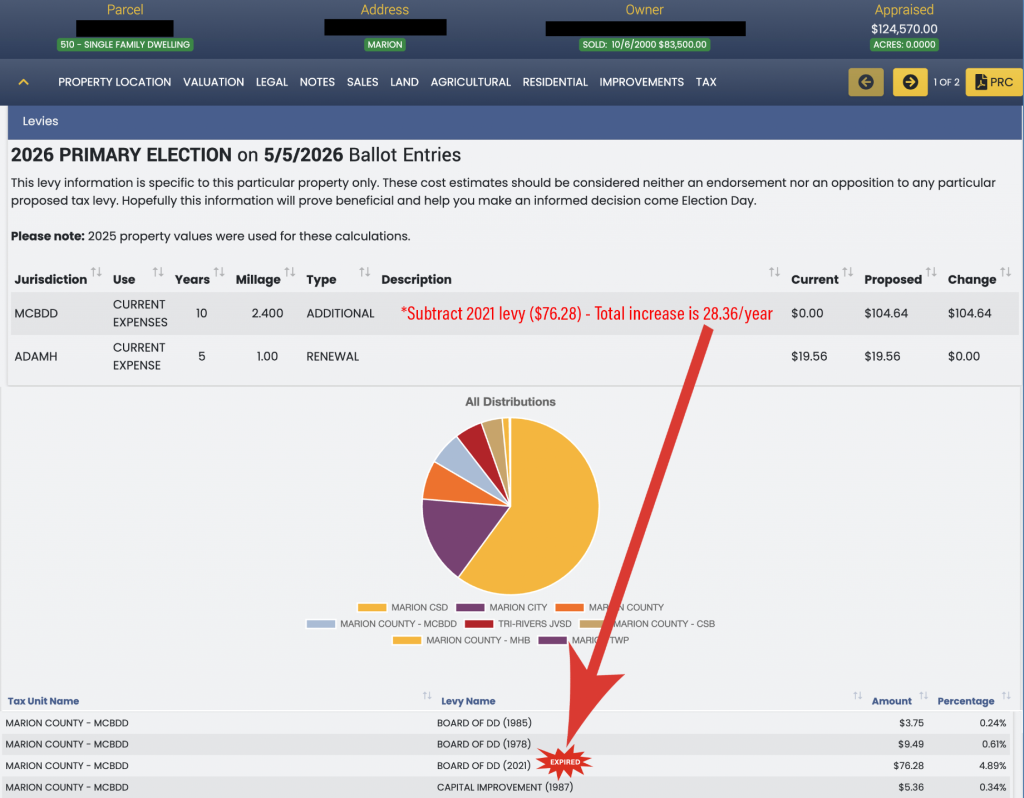
The proposed levy reduces the current rate from 3.0 mills to 2.4 mills, but it will ensure the valuation reflects today’s property values. For homeowners, this means an annual cost of $84 per year for a home valued at $100,000.
MCBDD is also seeking to extend the levy’s term from five years to a ten-year fixed rate, a commitment to voters, and a move aimed at providing long-term financial stability and avoiding the need for frequent ballot renewals. The board also has a separate 0.5 mill Capital levy held at the 1985 collection rate due for renewal in 2026.
It is important to note that the 2020 levy has expired, and MCBDD will no longer collect revenue from that levy. Here is a sample from the auditor’s site to see this in dollars and cents. You can also see your exact property by clicking here: https://tinyurl.com/4jb27xpv
6. What is the levy money going to pay for?
MCBDD has four levies. Three levies are strictly used for operational purposes. This means it funds the overall operation of our services. These are the dollars used to directly support those in our community with developmental disabilities. Based on available resources, MCBDD may provide or arrange for service and support administration (SSA services), early childhood services, supported living/residential services, family support, employment services, Special Olympics, assistive technology, remote supports, and many others. In 2025 alone, our organization connected those served with over 60,000 resources and support opportunities.
The fourth levy is a capital levy. This levy funds the infrastructure, including facilities, maintenance, and general upkeep of the grounds and buildings.
Only two of our levies remain on the ballot, one of each type listed above. They are renewed or replaced every 5 years (renewed in 2020 for operating purposes and requested for renewal in 2022 for capital purposes). The renewals and replacements help fund the continuation of existing services for individuals in our community with developmental disabilities, covering the increased costs of providing these services. We continually evaluate our funds, cut costs where possible, and still provide services and support to enable those we serve to lead fulfilling, independent, and inclusive lives.
The funding provided to MCBDD is the primary means of supporting individuals with developmental disabilities (DD) within our community. These are essential services that enable individuals with DD to live in our community rather than in an institution. The County Board of DD has demonstrated extreme fiscal responsibility by maximizing every local dollar, collecting roughly $1.50 on every waiver dollar, and receiving state subsidies. Going without a “raise” while all costs continue to climb is very difficult to do. Community support is essential to help your neighbors with developmental disabilities live, learn, and earn in our community.
7. What levies does the County Board of DD currently have, and what are they for? At what rate do you collect from property owners?
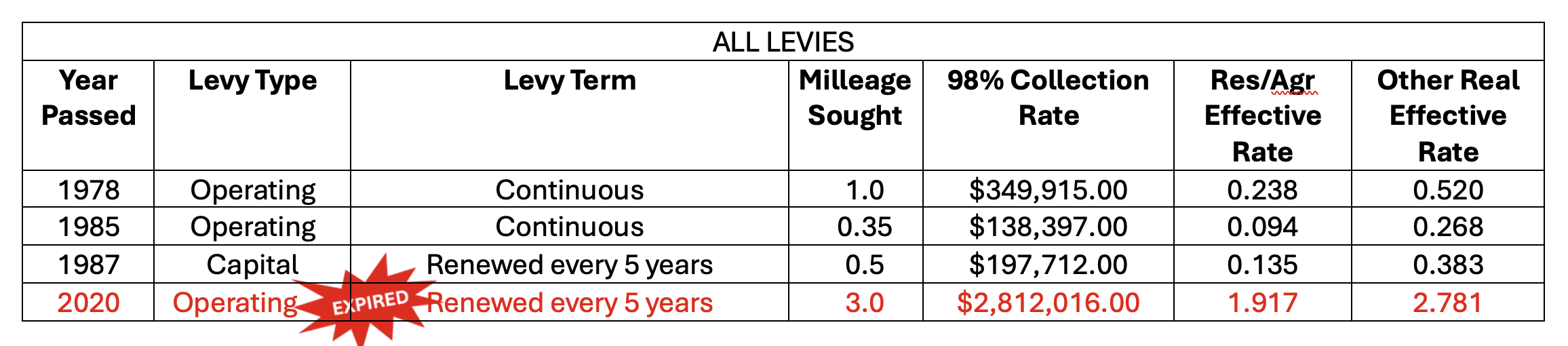
Here’s a screenshot of the types of MCBDD levies and what we are currently collecting. As you can see, as levies age, we do not collect at today’s effective rate but at the rate in effect when they were passed. Because of this, they lose value over time and do not keep pace with the cost of doing business (inflation). We also do not collect at 100 percent, but at a lower rate than the approved levy, due to delinquent property taxes, vacant homes, and other factors. It is also important to note that the Capital levy funds can only be used for maintenance, facility improvements, and upkeep.
8. How does the Marion County Board of DD maintain fiscal responsibility?
MCBDD is fortunate enough to receive funding from local grants, the Federal Government (Medicaid), as well as state and local (levy) dollars.
- MCBDD receives $1.50 in federal dollars for every $1 of local funding for all services funded through a waiver. We have refinanced adult services, which have saved money and helped us secure these federal dollars.
- We undergo thorough reviews of our operations by the Ohio Department of Developmental Disabilities (DODD) and the Ohio Association of County Boards (OACB) to ensure that our organization, finances, and future are fiscally and operationally sound.
- We collaborate with agencies in Marion County to help the people we serve access resources and services in the most cost-effective manner.
- Our community has supported MCBDD through donations and grants. The Knights of Columbus fundraises to help support our Special Olympics programs. Marion Rotary Club, Marion Community Foundation, and the United Way have all granted MCBDD funds for various programs and services. We are grateful and appreciate this type of commitment to those we serve.
- Reduced our operational overhead by 47,000 square feet of facility space by selling two buildings and renovating one facility to encompass all employees for the first time in our history. The cost of this renovation will be recouped within seven years, creating long-term cost savings to our operating budget. Having the entire staff under one roof also creates a more effective and cohesive work environment for both staff and those they serve.
9. I’m on a fixed income and can’t afford an increase in my taxes.
You may still be able to support the work of the County Board of DD and reduce your taxes. If you’re 65 years old or older, you may qualify for the “Senior Homestead Exemption.” If eligible, you may qualify for an exemption of the first $25,000 of your home’s taxable value. Click here to review the application and learn more.
There are also exemptions available for individuals with disabilities and veterans. Contact your local tax assessor for complete details on property tax exemptions.
10. Since you have a “carryover” at the end of the year, why do you need to renew or replace levies?
The term “carryover” at the auditor’s office assumes that this is money that we simply have “sitting around.” The carryover is actually taxes collected and earmarked to pay current obligations until we receive our next tax collection (typically in March and August). This is similar to how most families manage their checking accounts—you hold onto funds for bills and upcoming expenses and need to keep a balance in that account for that purpose.
11. Do you still serve children even though you closed the Marca School?
Yes. The Marca school naturally dissolved years ago because parents wanted the opportunity for inclusion and diversity within our city and county schools. The funding previously received by MCBDD for educating those children followed them to their local school districts, where they receive services in a more inclusive environment. We currently serve over 350 school-age children through Service Support Administration (SSA) services and by providing supplemental support outside of school. We are grateful to our local school districts, who work beside us as partners to ensure school-age children are supported.
12. Why are administrative costs so high?
This is a myth. Statewide studies have indicated that MCBDD salaries are within the average range for similar positions. Salaries are determined by several factors, including a statewide suggested salary scale, education, years of experience, and performance. There are state and federal funds specifically allocated to offset salary and benefit costs. For example, our Superintendent’s salary is funded at a level of 72% state and federal dollars (not local tax dollars). The County Board of DD’s role is to administer, coordinate, and locate resources; therefore, the administrative salaries reflect this role. The bulk of your local dollars does not go toward salaries; instead, they support services for individuals in the community with Developmental Disabilities (83% of overall funds go directly toward supports for those served).